Number 13 · Year 8
Multiplying and Dividing Negative Numbers
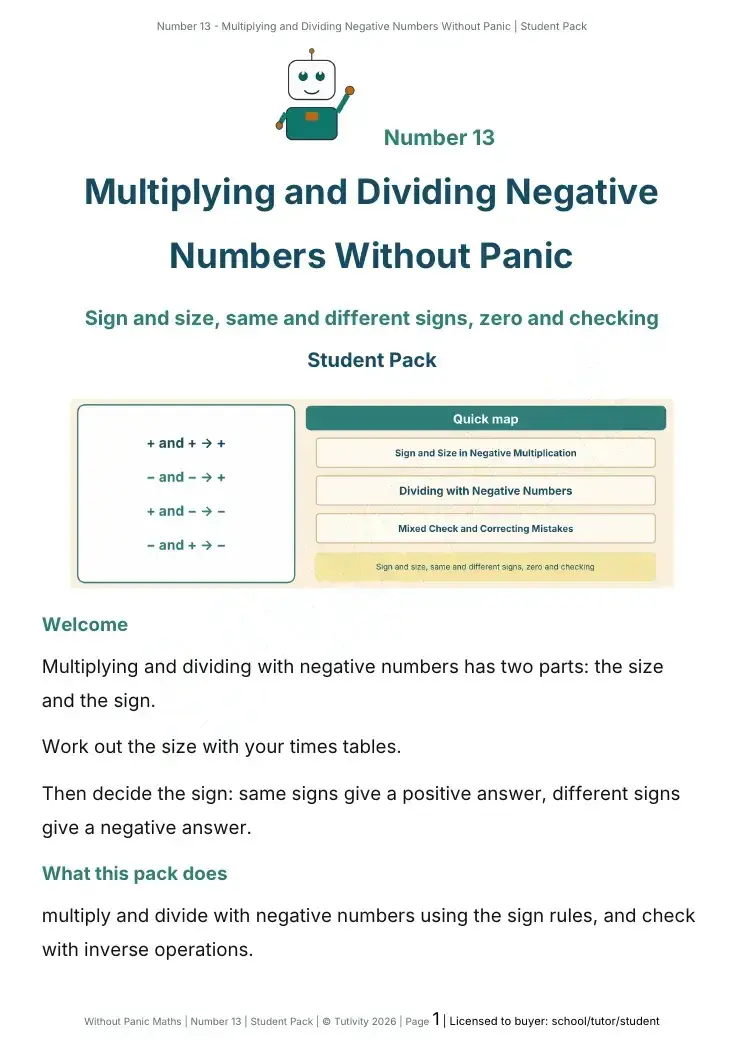
Multiplying and dividing with negative numbers has two parts: the size and the sign. Work out the size with your times tables.
£3.50
Without Panic Maths · Number 51
Normalising, multiplying, dividing, adding, subtracting, calculator E notation and contexts
What this pack does
To multiply in standard form, multiply the front numbers and add the powers. To divide, divide the front numbers and subtract the powers. To add or subtract, match the powers first. Always finish with a valid front number.
Inside every pack
Pupils tick how a topic feels before they start, and again at the end. There are no marks, so it's an honest picture of where they are.
Each topic is split into small steps. Every mini-lesson opens with one big idea and a short, plain-English explanation.
Diagrams such as a formula 'rule machine' or a place-value picture show the maths, so pupils can see it as well as read it.
Every method is modelled step by step before pupils try it, with each stage labelled so they can follow it on their own.
Questions start with prompts (what do you need to find, follow the example, check it makes sense) and gradually ask for more independence.
Common mistakes are named before pupils make them, and Mistake Detective questions ask them to find and fix errors.
Short 'explain it in your own words' prompts check that pupils understand why the maths works, not just how.
Every pack comes with a Teacher Pack: all the answers, plus reteach cards saying what to watch for, what to say, and what to try if a pupil is still stuck.
More number packs
Multiplying and dividing with negative numbers has two parts: the size and the sign. Work out the size with your times tables.
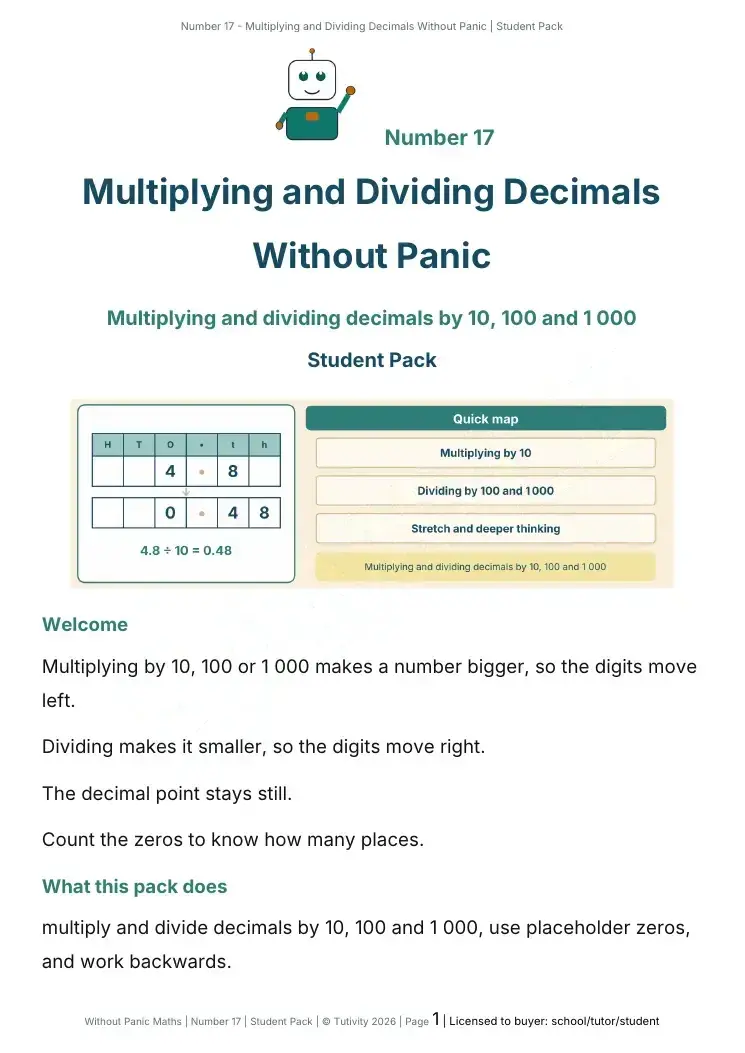
Multiplying by 10, 100 or 1 000 makes a number bigger, so the digits move left. Dividing makes it smaller, so the digits move right. The decimal point stays still. Count the zeros to know how many places.
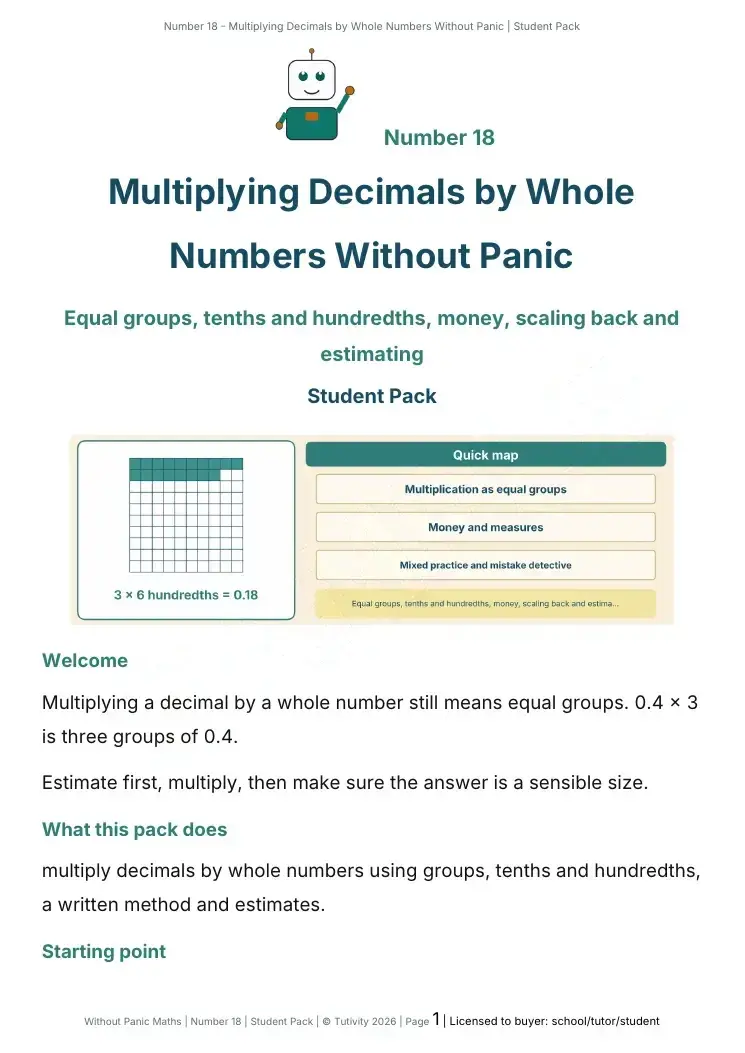
Multiplying a decimal by a whole number still means equal groups. 0.4 × 3 is three groups of 0.4. Estimate first, multiply, then make sure the answer is a sensible size.