Without Panic Maths · Probability 9

Sets and Venn Diagrams

Understand sets and elements; read and fill two-set Venn diagrams; use intersection, union and complement language; and find simple probabilities by counting equally likely elements in the correct region.

£3.50Go to basket

Secure checkout by Stripe · Instant PDF download

Mini-lessons
7
Questions
124
Student Pack
79 pages
Suggested year
Year 9

What you get

  • Student Pack (PDF, 79 pages)
  • Teacher Pack (PDF) with every answer and reteach cards
  • Print as many copies as you need for your own pupils

Save with a bundle

  • Probability, Year 94 packs · £10.50 £9
  • Probability: complete strand12 packs · £35 £31

What this pack does

What pupils learn

Understand sets and elements; read and fill two-set Venn diagrams; use intersection, union and complement language; and find simple probabilities by counting equally likely elements in the correct region.

The mini-lessons

  1. Sets are collections of elements
  2. A two-set Venn diagram has four regions
  3. Intersection and union name useful regions
  4. The complement: everything not in A
  5. Fill a Venn diagram before trusting it
  6. Probability from a Venn diagram is still favourable over total
  7. Check the region before you check the arithmetic

Inside every pack

What each part of the page is for

  1. Confidence check

    Pupils tick how a topic feels before they start, and again at the end. There are no marks, so it's an honest picture of where they are.

  2. Short mini-lessons

    Each topic is split into small steps. Every mini-lesson opens with one big idea and a short, plain-English explanation.

  3. Visuals for every idea

    Diagrams such as a formula 'rule machine' or a place-value picture show the maths, so pupils can see it as well as read it.

  4. Worked examples

    Every method is modelled step by step before pupils try it, with each stage labelled so they can follow it on their own.

  5. Scaffolded practice

    Questions start with prompts (what do you need to find, follow the example, check it makes sense) and gradually ask for more independence.

  6. Spot the trap

    Common mistakes are named before pupils make them, and Mistake Detective questions ask them to find and fix errors.

  7. Pause and think

    Short 'explain it in your own words' prompts check that pupils understand why the maths works, not just how.

  8. Teacher Pack with answers

    Every pack comes with a Teacher Pack: all the answers, plus reteach cards saying what to watch for, what to say, and what to try if a pupil is still stuck.

More probability packs

Probability 5 · Year 8

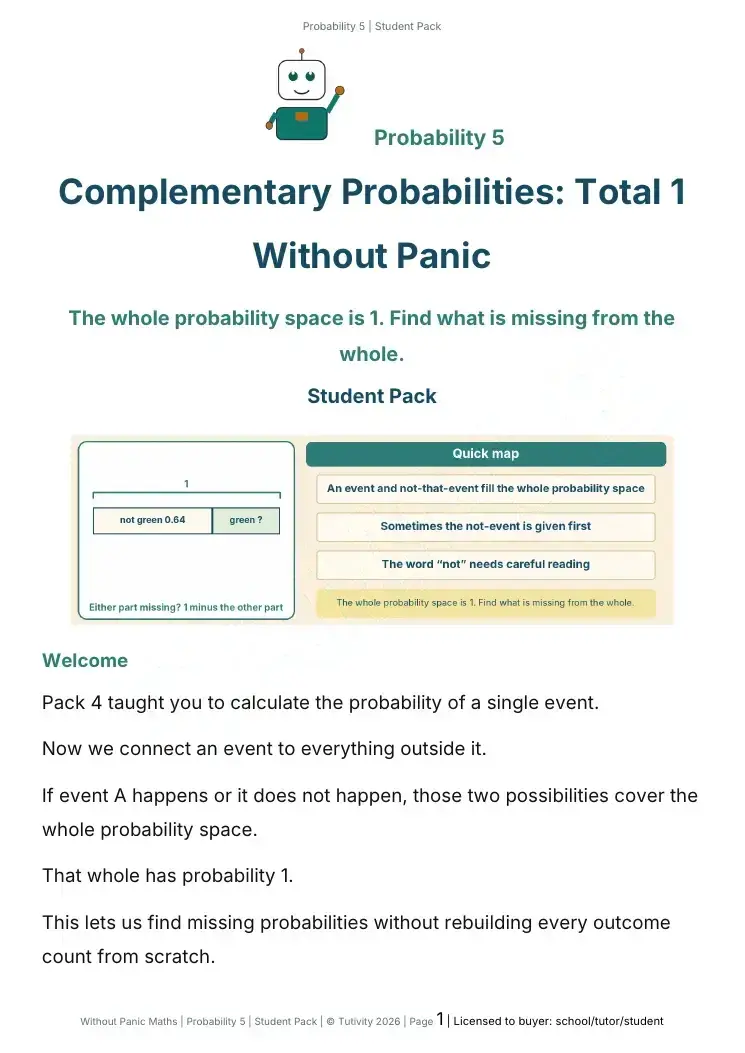
Complementary Probabilities Total 1

Pack 4 taught you to calculate the probability of a single event. Now we connect an event to everything outside it. If event A happens or it does not happen, those two possibilities cover the whole probability space.

£3.50
Probability 6 · Year 8

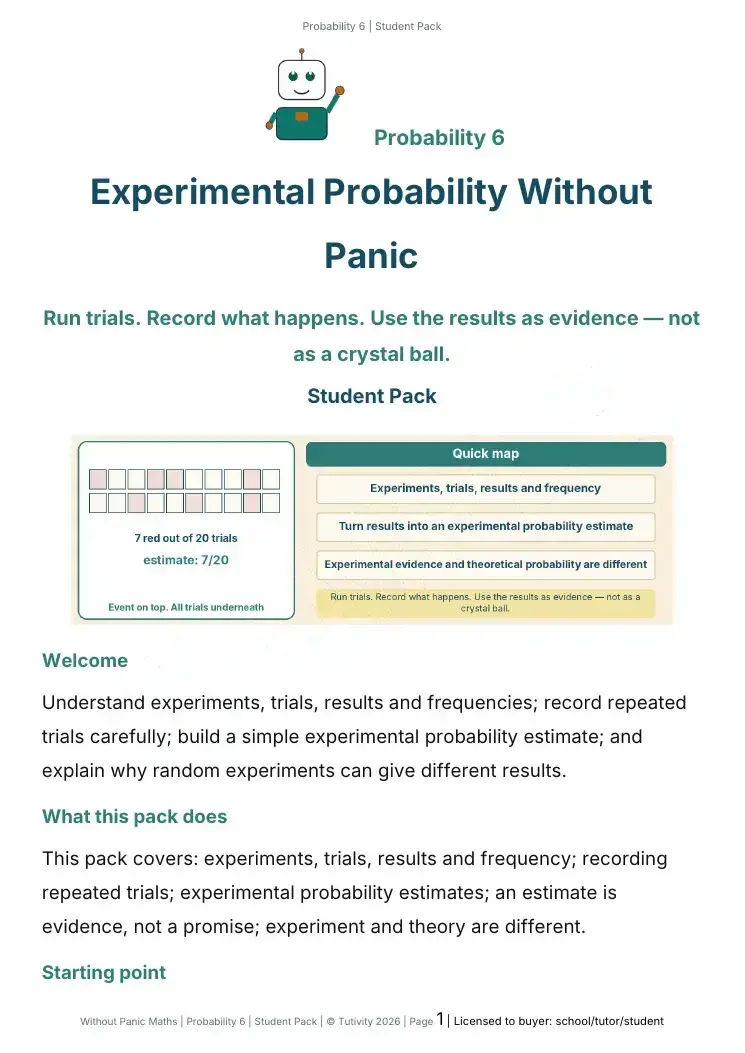
Experimental Probability

Understand experiments, trials, results and frequencies; record repeated trials carefully; build a simple experimental probability estimate; and explain why random experiments can give different results.

£3.50
Probability 7 · Year 8

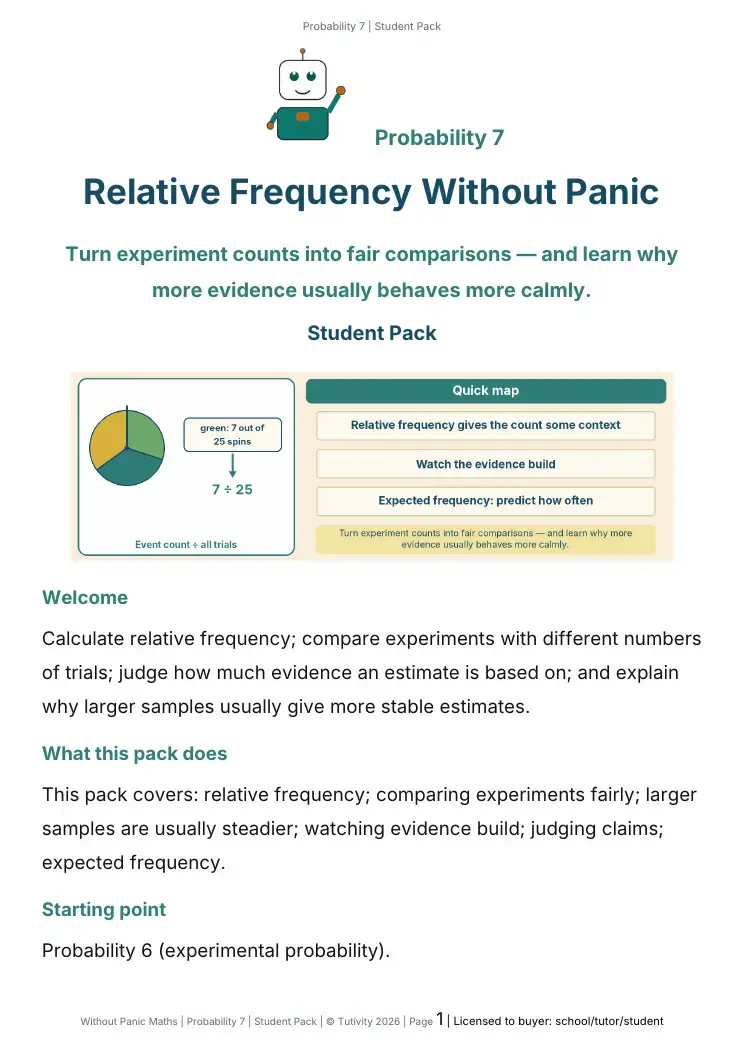
Relative Frequency

Turn experiment counts into fair comparisons — and learn why more evidence usually behaves more calmly.

£3.50

See all packs