Without Panic Maths
KS3 maths packs that do the teaching
Calm, carefully sequenced KS3 maths packs that do the teaching for you. Each topic is broken into short mini-lessons, every idea is shown visually and worked through step by step, and pupils practise straight away with plenty of support.
- 209 packs across 6 strands
- £3.50 per pack
- 12 free packs to try
Try before you buy
The first pack in every strand and every diagnostic assessment are free, including their Teacher Packs. Start with a diagnostic to find exactly which packs a pupil needs.
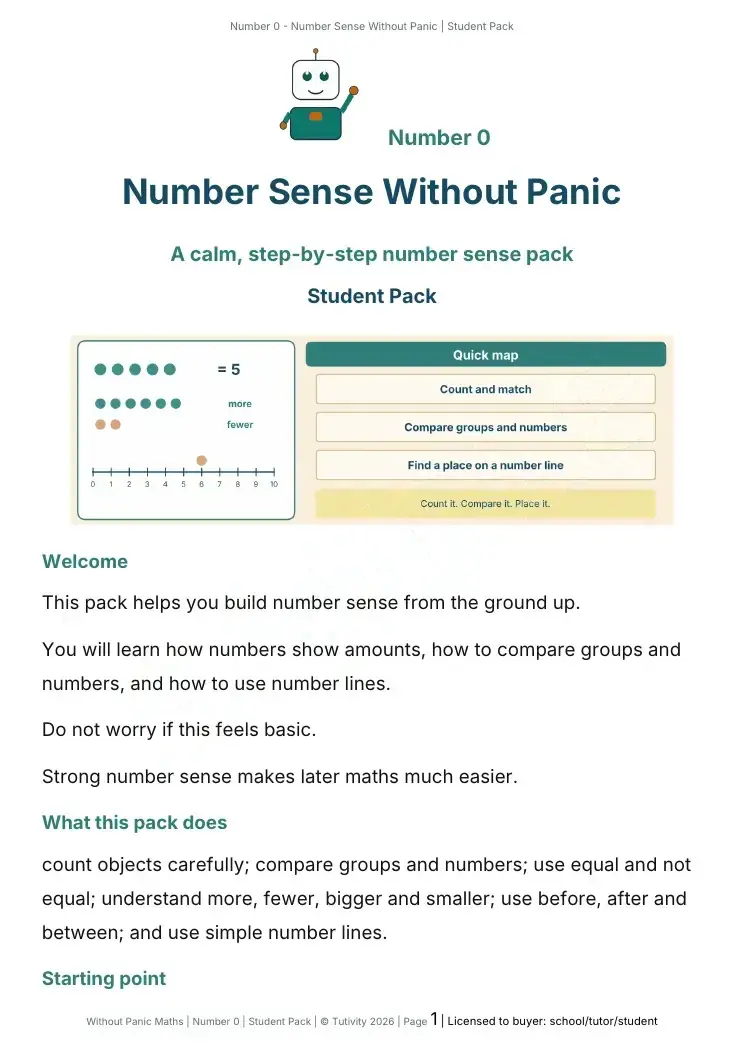
- Number 0: Number Sense
- Number 53: Number Review and Diagnostic Assessment
- Algebra 1: Algebra Before Algebra
- Algebra 46: KS3 Algebra Final Diagnostic Assessment
- Geometry 1: Geometry Language Foundations
- Geometry 50: Geometry and Measures Diagnostic Assessment
- Ratio 1: Multiplicative Thinking Foundations
- Ratio 27: Ratio, Proportion and Rates Diagnostic Assessment
- Statistics 1: Data Language Foundations
- Statistics 18: Statistics Diagnostic Assessment
- Probability 1: Probability Language
- Probability 12: Probability Diagnostic Assessment
Mix and match
Buy exactly what your pupil needs
Pick a single topic, a group of related topics, one strand for one year, or everything. Combine them however you like: packs already in a bundle are never charged twice.
A single topic
One gap to fill
Number 24: Prime Factorisation
£3.50
A topic bundle
A whole topic, start to finish
Factors, Primes & Powers
£19
One strand, one year
A year's work in one area
Algebra, Year 7
£46
A whole strand
Every year, one area
Algebra: complete strand
£142
Example: a Year 8 pupil who finds fractions and probability hard. Add the Fractions topic bundle (£28) and Probability, Year 8 (£12): 13 packs for £40 instead of £45.50.
See all topic and year bundlesHow the packs work
Every pack follows the same calm structure
Pupils always know what's coming next. That predictability matters, especially for pupils who find maths stressful.
Confidence check
Pupils tick how a topic feels before they start, and again at the end. There are no marks, so it's an honest picture of where they are.
Short mini-lessons
Each topic is split into small steps. Every mini-lesson opens with one big idea and a short, plain-English explanation.
Visuals for every idea
Diagrams such as a formula 'rule machine' or a place-value picture show the maths, so pupils can see it as well as read it.
Worked examples
Every method is modelled step by step before pupils try it, with each stage labelled so they can follow it on their own.
Scaffolded practice
Questions start with prompts (what do you need to find, follow the example, check it makes sense) and gradually ask for more independence.
Spot the trap
Common mistakes are named before pupils make them, and Mistake Detective questions ask them to find and fix errors.
Pause and think
Short 'explain it in your own words' prompts check that pupils understand why the maths works, not just how.
Teacher Pack with answers
Every pack comes with a Teacher Pack: all the answers, plus reteach cards saying what to watch for, what to say, and what to try if a pupil is still stuck.
All packs
Find the right pack
Filter by strand and year group, then open any pack to see six real pages from inside.
209 packs
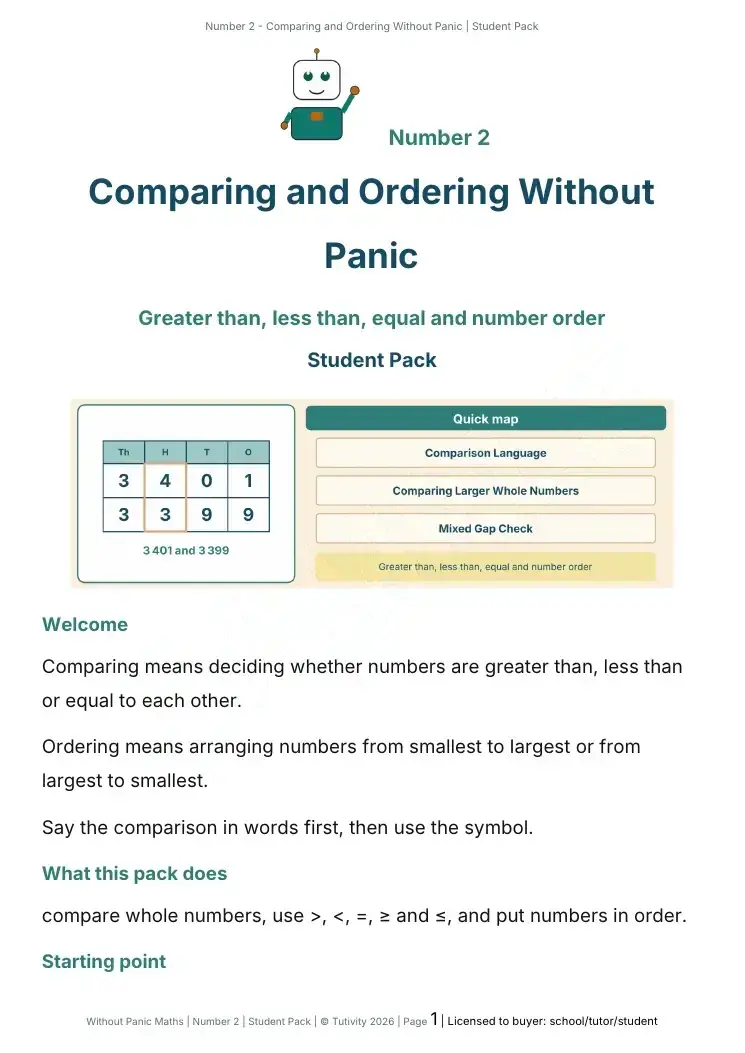
Comparing and Ordering
Comparing means deciding whether numbers are greater than, less than or equal to each other. Ordering means arranging numbers from smallest to largest or from largest to smallest.
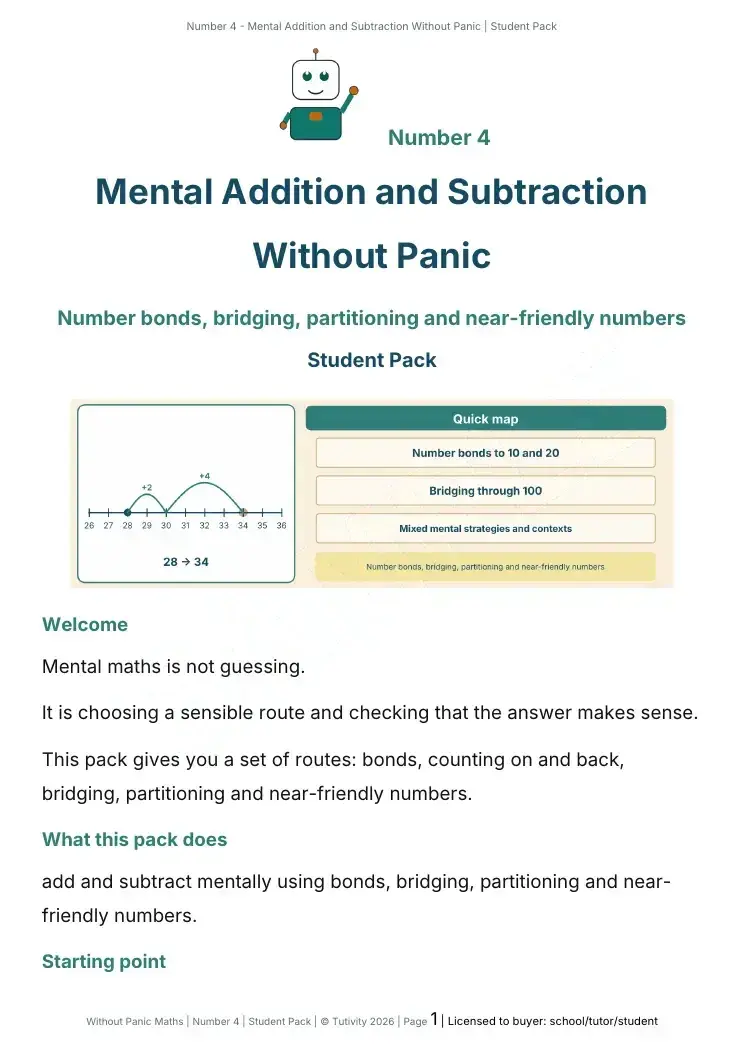
Mental Addition and Subtraction
Mental maths is not guessing. It is choosing a sensible route and checking that the answer makes sense. This pack gives you a set of routes: bonds, counting on and back, bridging, partitioning and near-friendly numbers.
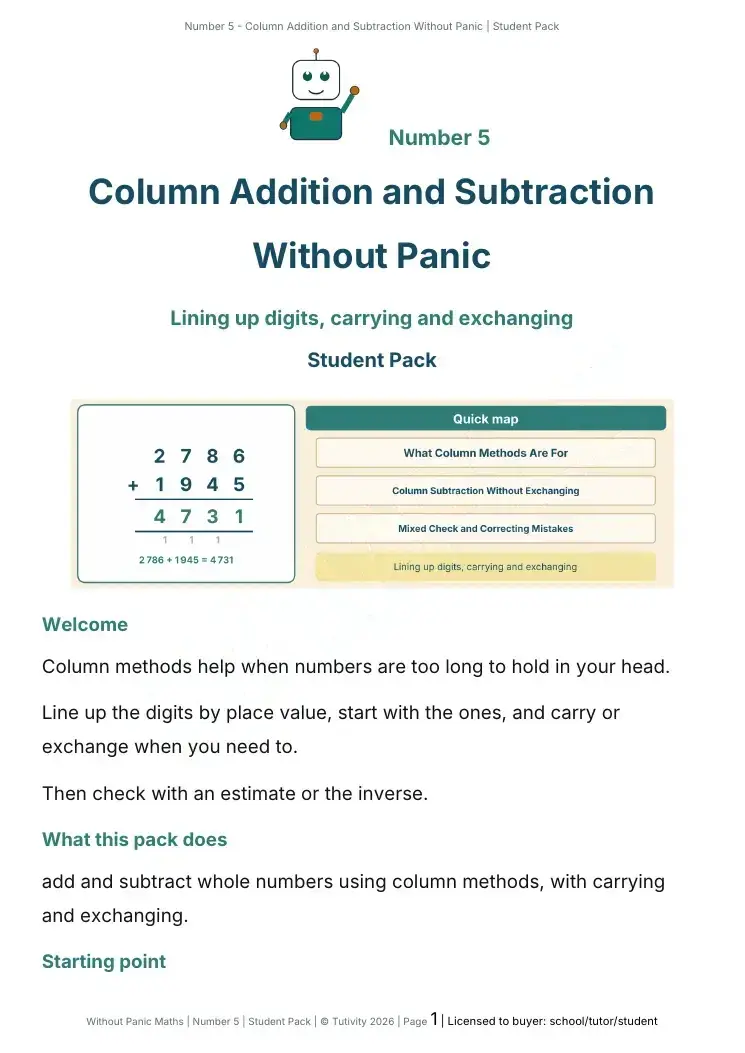
Column Addition and Subtraction
Column methods help when numbers are too long to hold in your head. Line up the digits by place value, start with the ones, and carry or exchange when you need to. Then check with an estimate or the inverse.
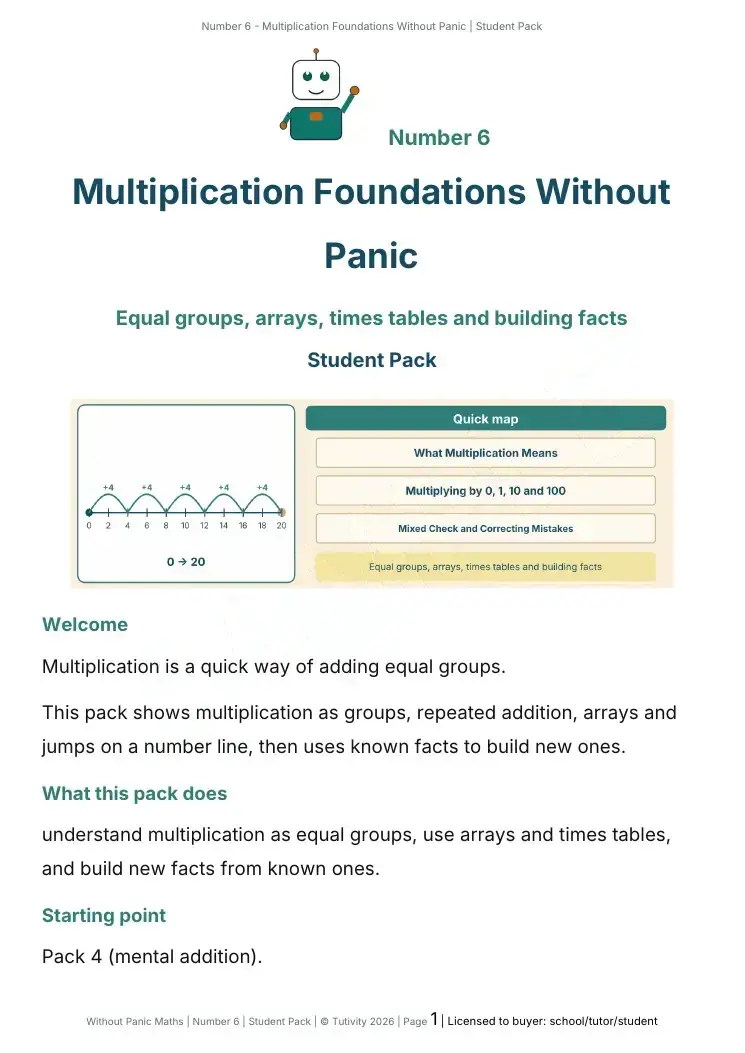
Multiplication Foundations
Multiplication is a quick way of adding equal groups. This pack shows multiplication as groups, repeated addition, arrays and jumps on a number line, then uses known facts to build new ones.
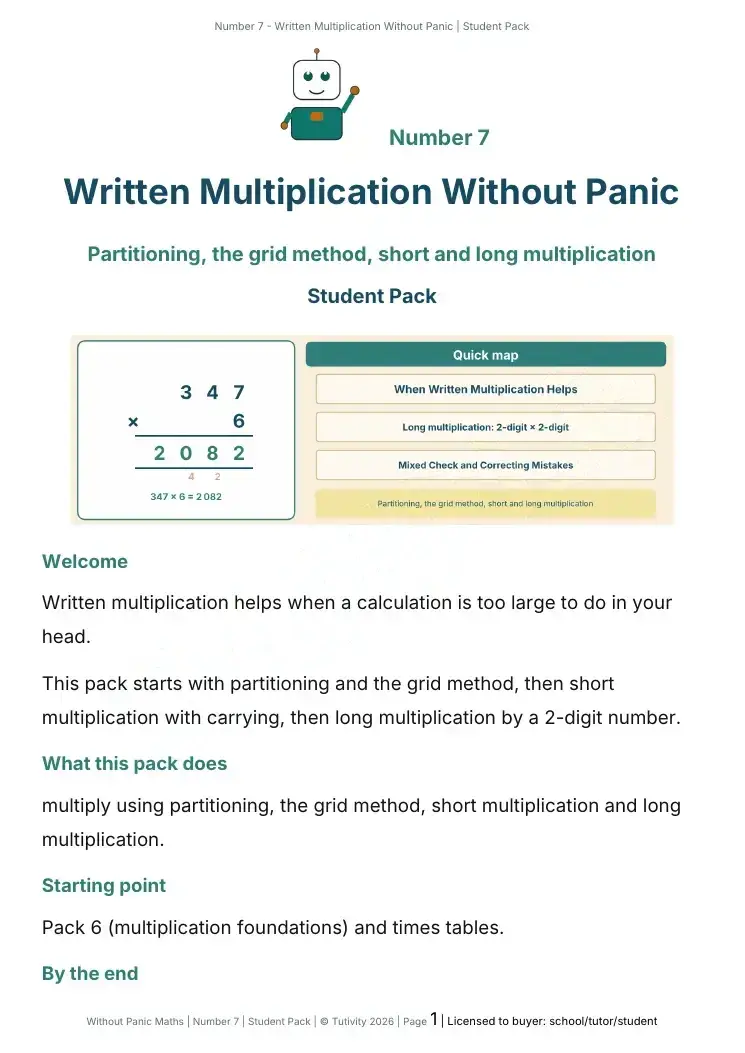
Written Multiplication
Partitioning, the grid method, short and long multiplication
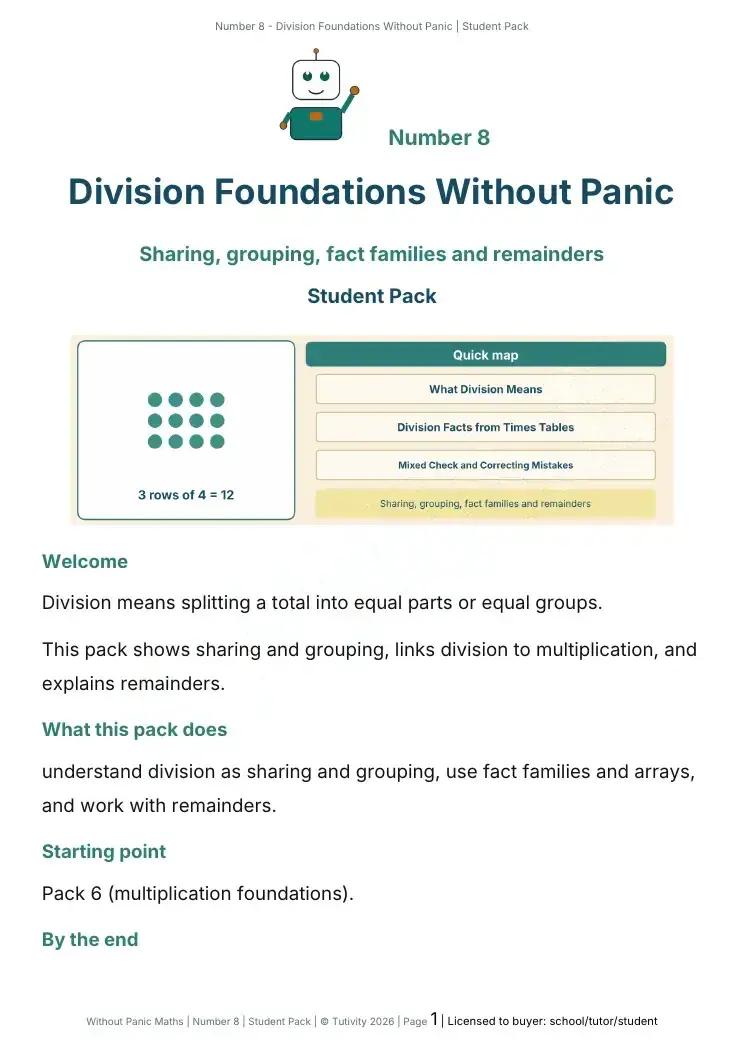
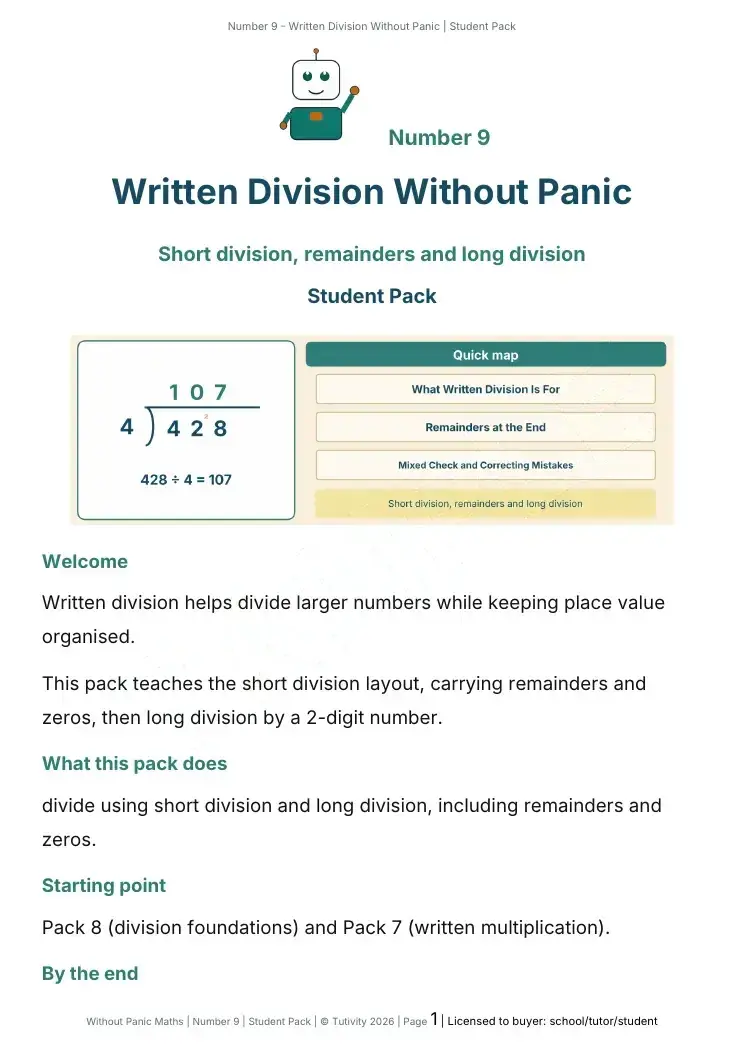
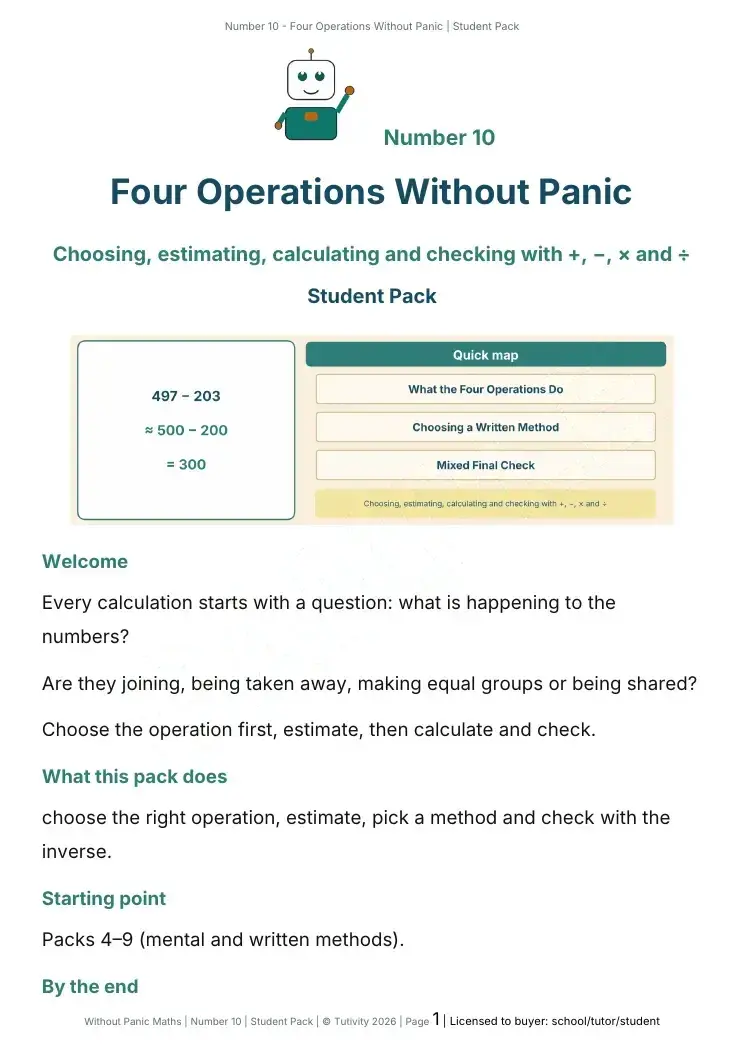
Four Operations
Choosing, estimating, calculating and checking with +, −, × and ÷
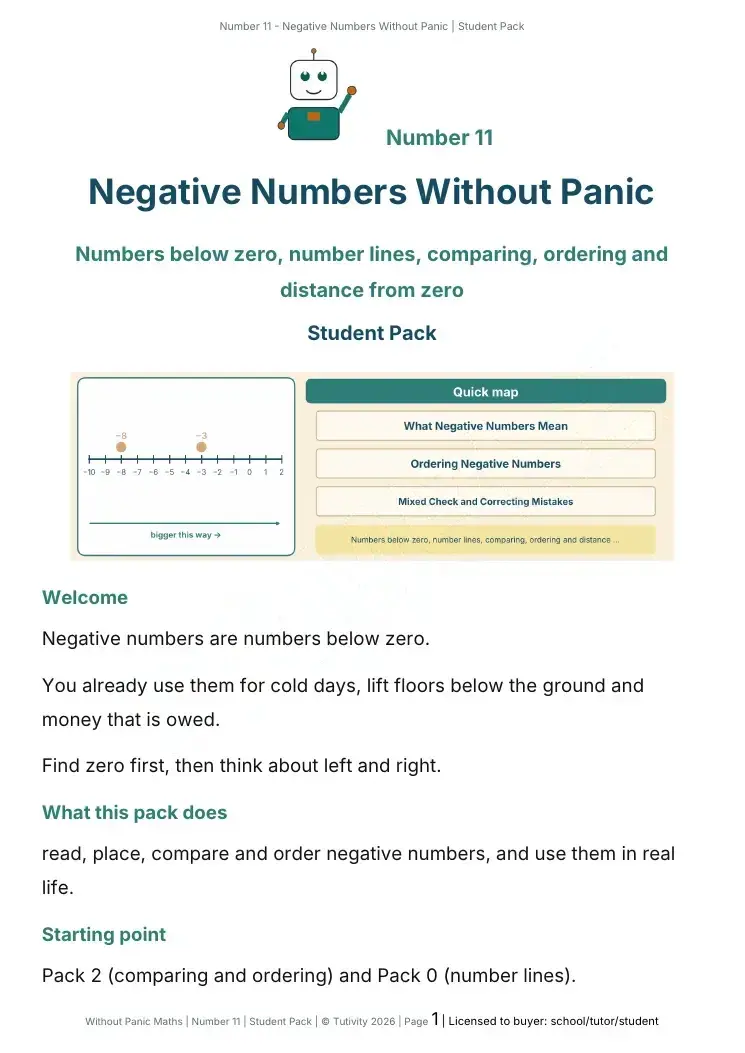
Negative Numbers
Numbers below zero, number lines, comparing, ordering and distance from zero
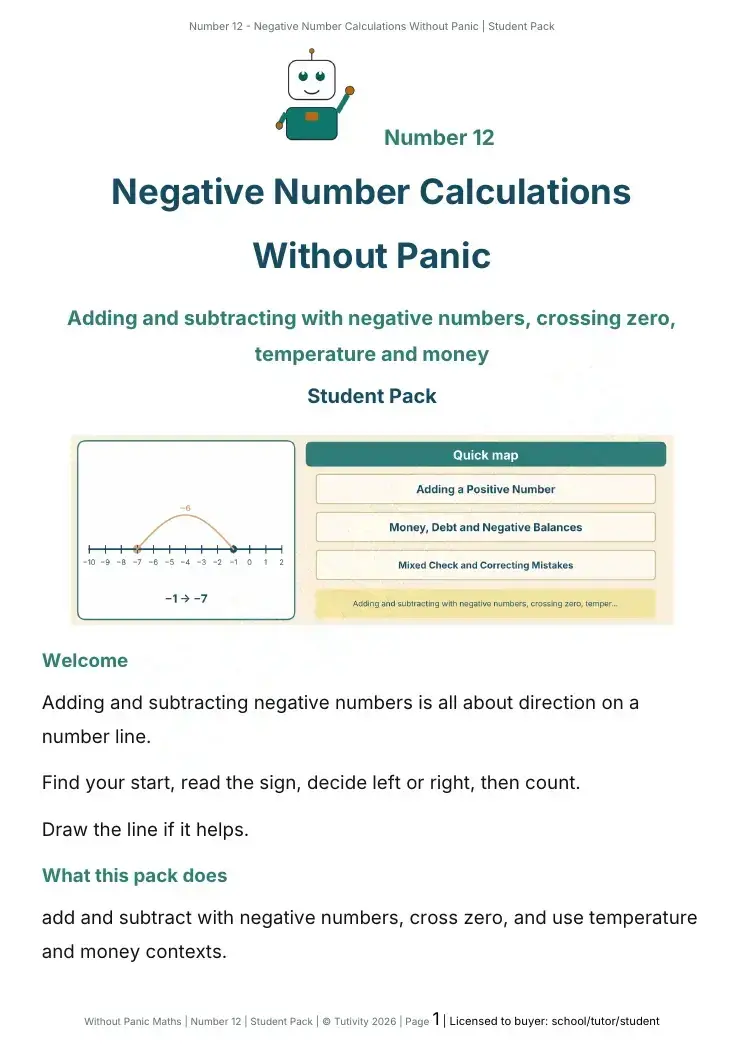
Negative Number Calculations
Adding and subtracting negative numbers is all about direction on a number line. Find your start, read the sign, decide left or right, then count. Draw the line if it helps.
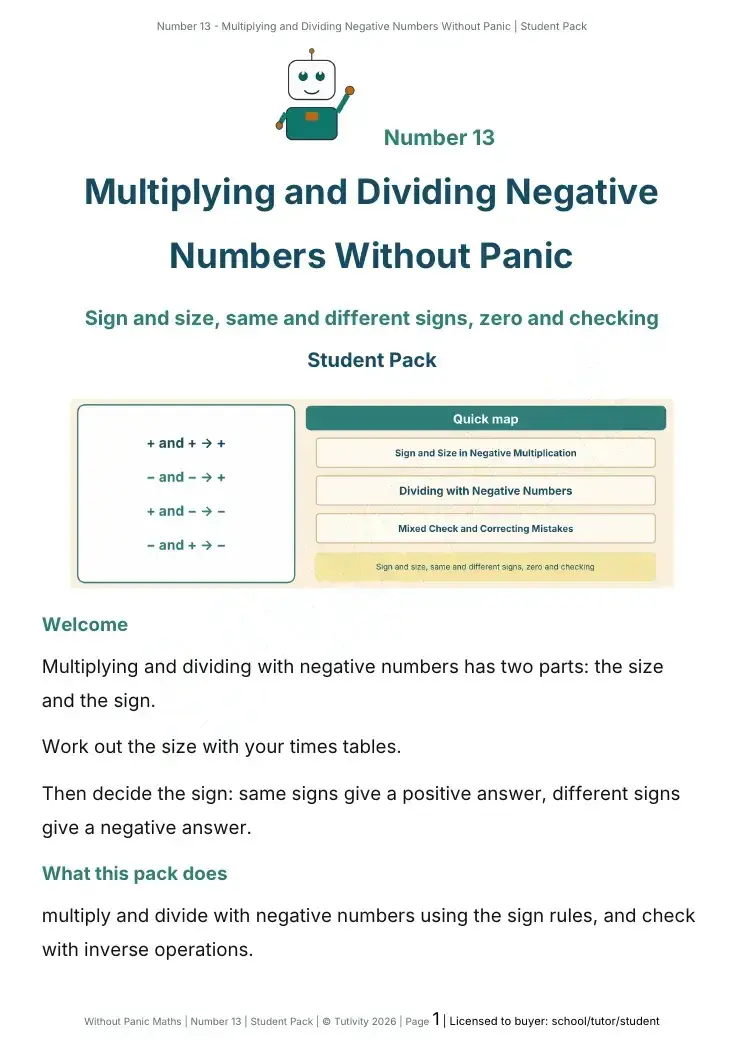
Multiplying and Dividing Negative Numbers
Multiplying and dividing with negative numbers has two parts: the size and the sign. Work out the size with your times tables.
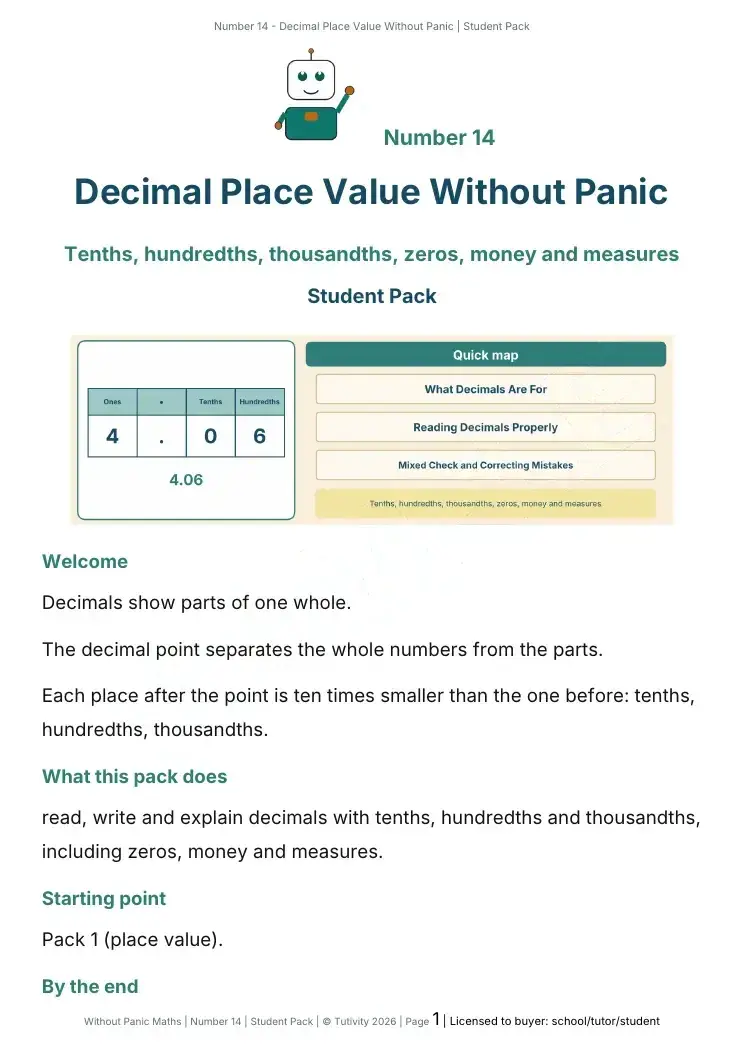
Decimal Place Value
Tenths, hundredths, thousandths, zeros, money and measures
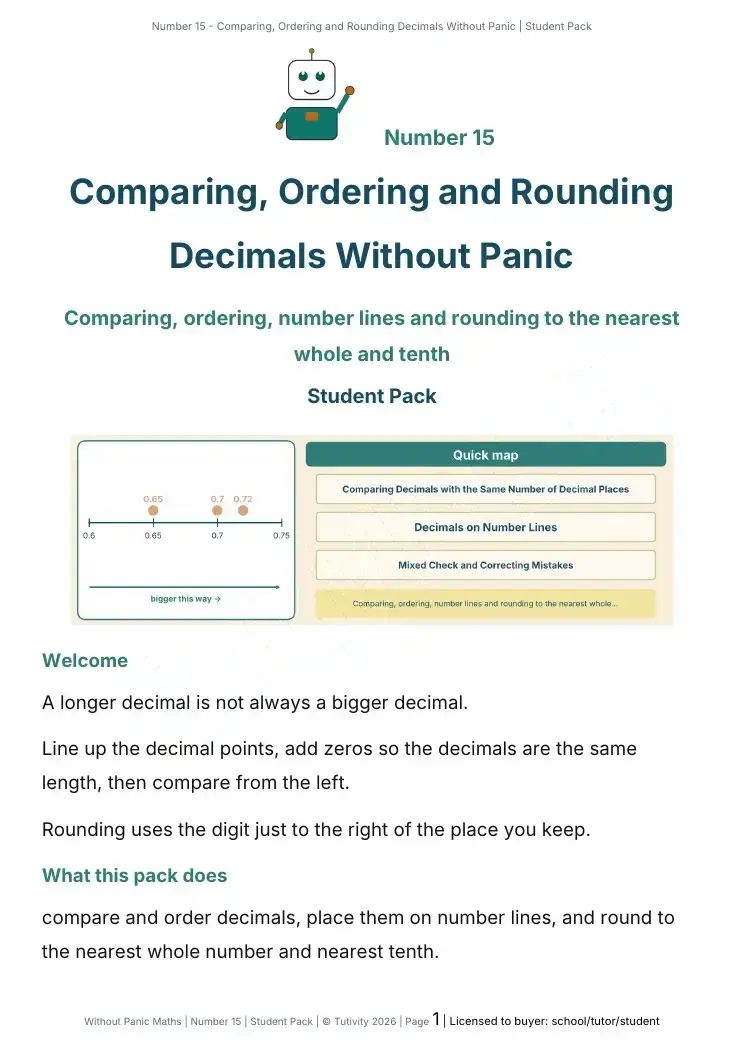
Comparing, Ordering and Rounding Decimals
A longer decimal is not always a bigger decimal. Line up the decimal points, add zeros so the decimals are the same length, then compare from the left. Rounding uses the digit just to the right of the place you keep.
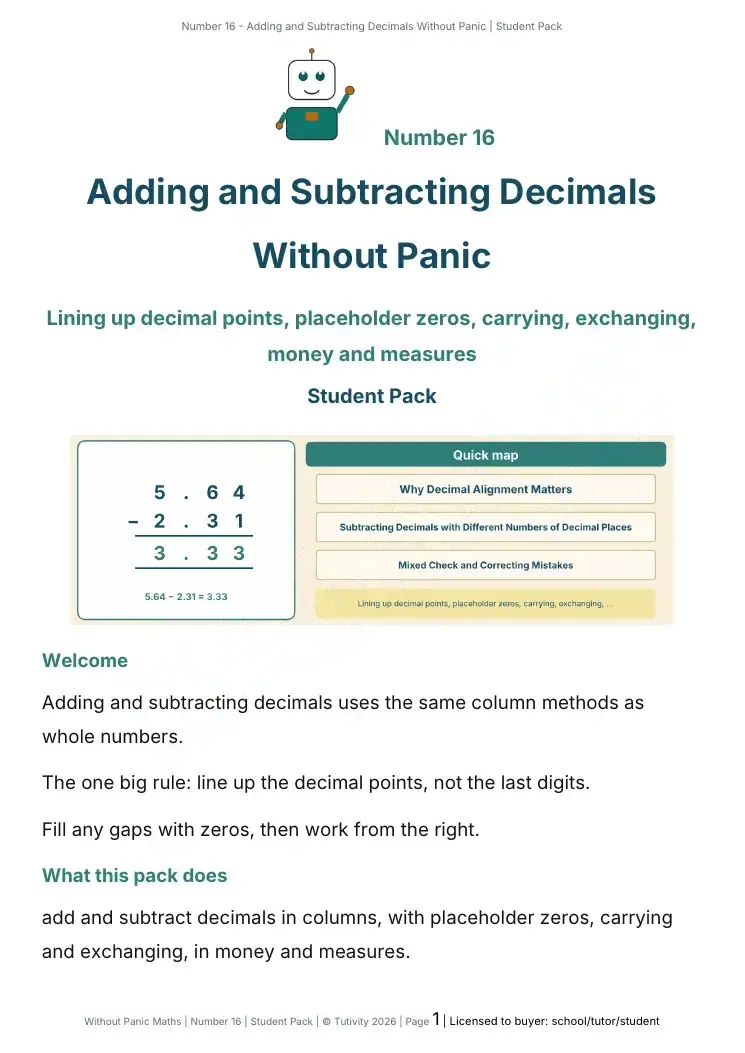
Adding and Subtracting Decimals
Adding and subtracting decimals uses the same column methods as whole numbers. The one big rule: line up the decimal points, not the last digits. Fill any gaps with zeros, then work from the right.
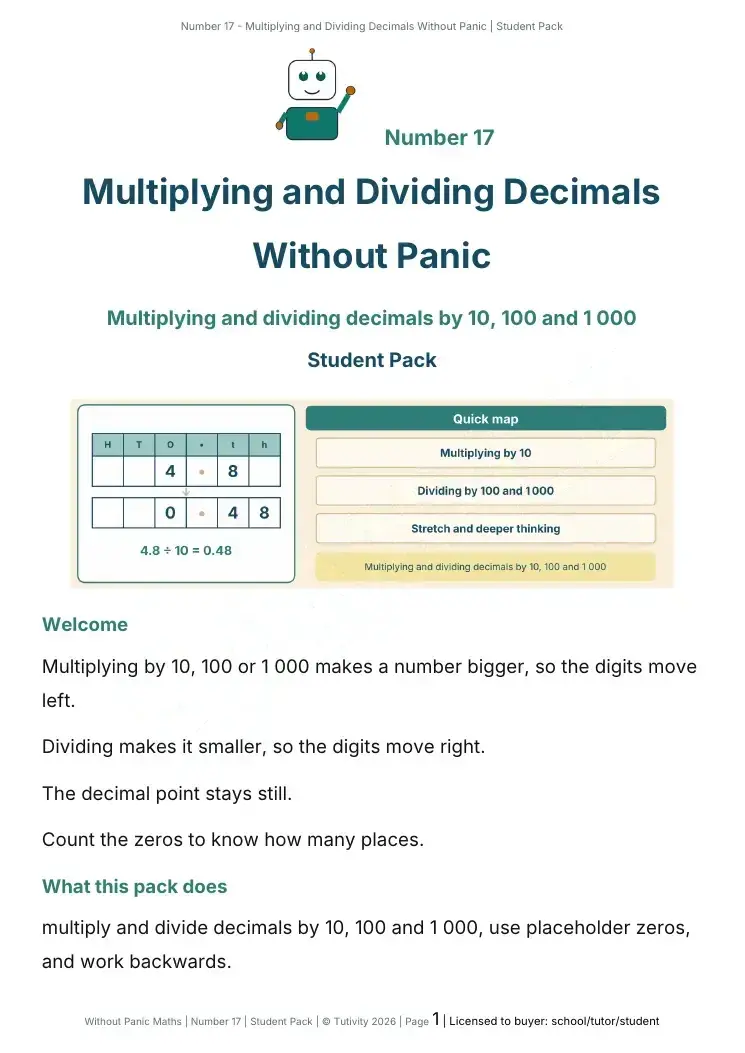
Multiplying and Dividing Decimals
Multiplying by 10, 100 or 1 000 makes a number bigger, so the digits move left. Dividing makes it smaller, so the digits move right. The decimal point stays still. Count the zeros to know how many places.
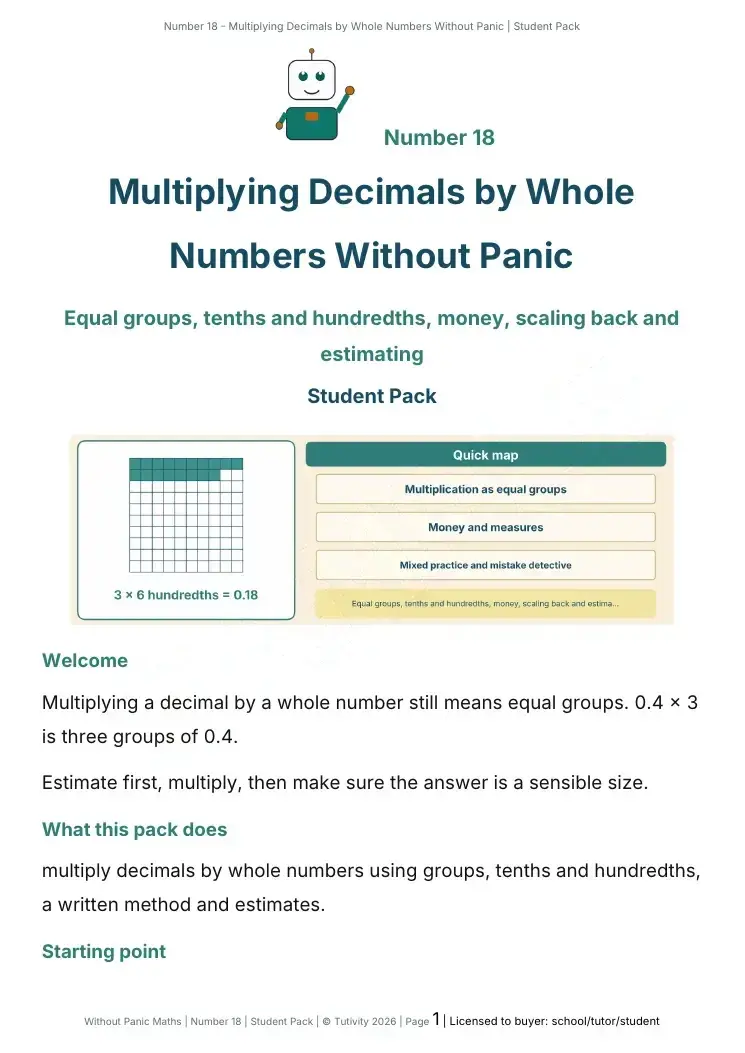
Multiplying Decimals by Whole Numbers
Multiplying a decimal by a whole number still means equal groups. 0.4 × 3 is three groups of 0.4. Estimate first, multiply, then make sure the answer is a sensible size.
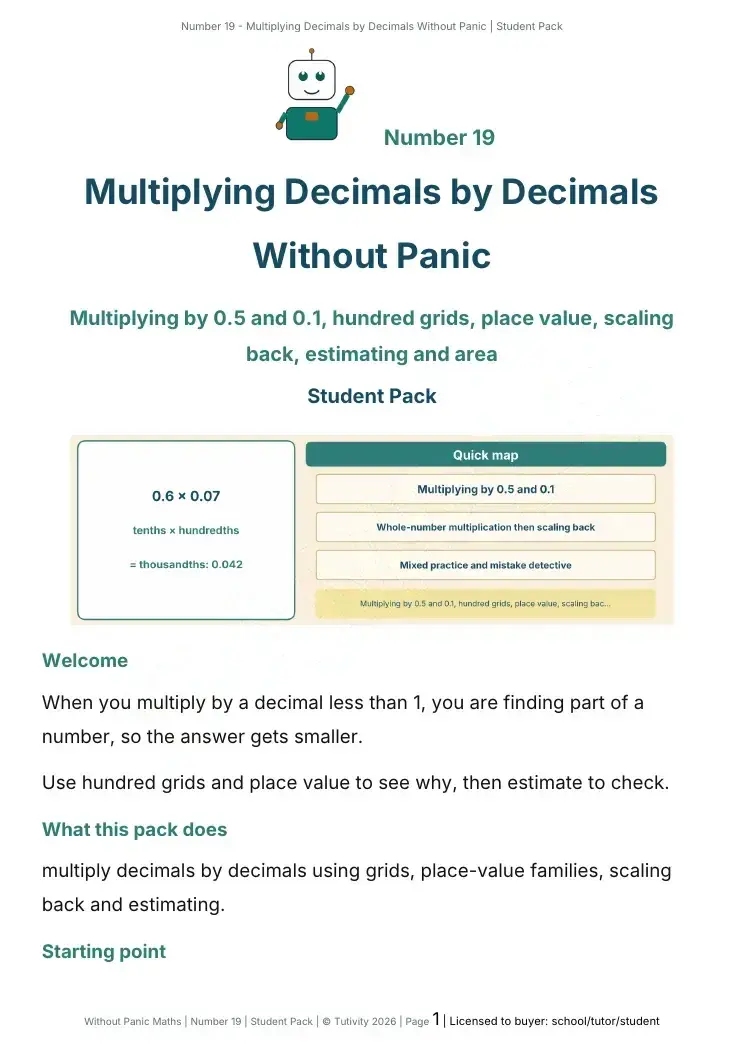
Multiplying Decimals by Decimals
When you multiply by a decimal less than 1, you are finding part of a number, so the answer gets smaller. Use hundred grids and place value to see why, then estimate to check.
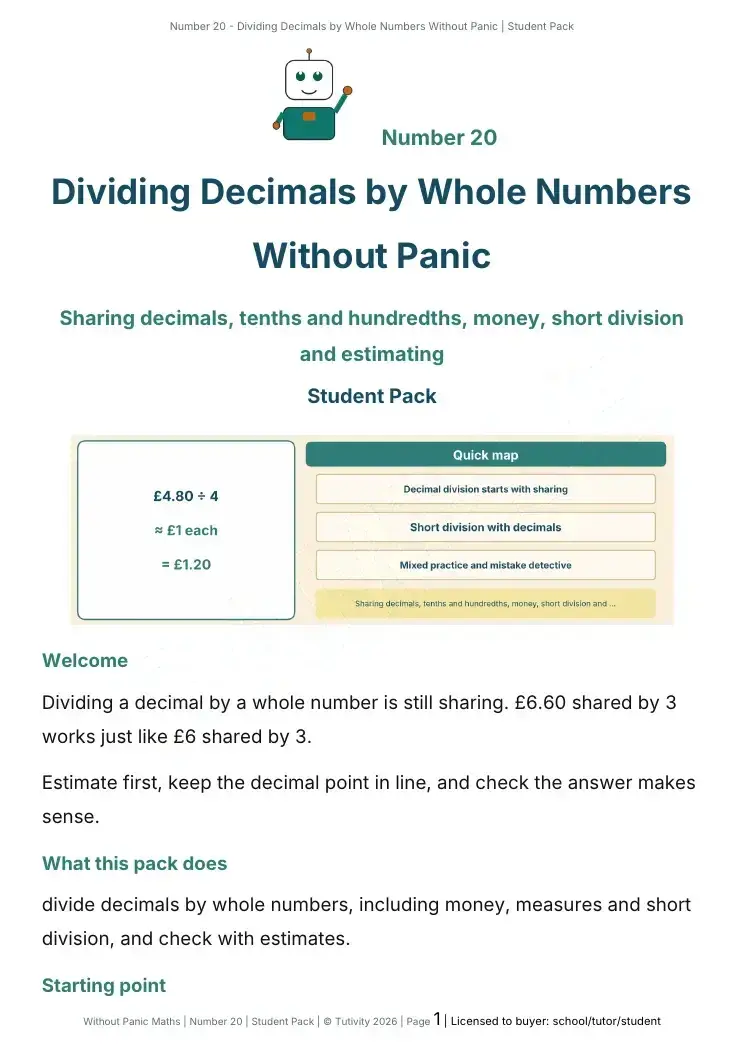
Dividing Decimals by Whole Numbers
Dividing a decimal by a whole number is still sharing. £6.60 shared by 3 works just like £6 shared by 3. Estimate first, keep the decimal point in line, and check the answer makes sense.
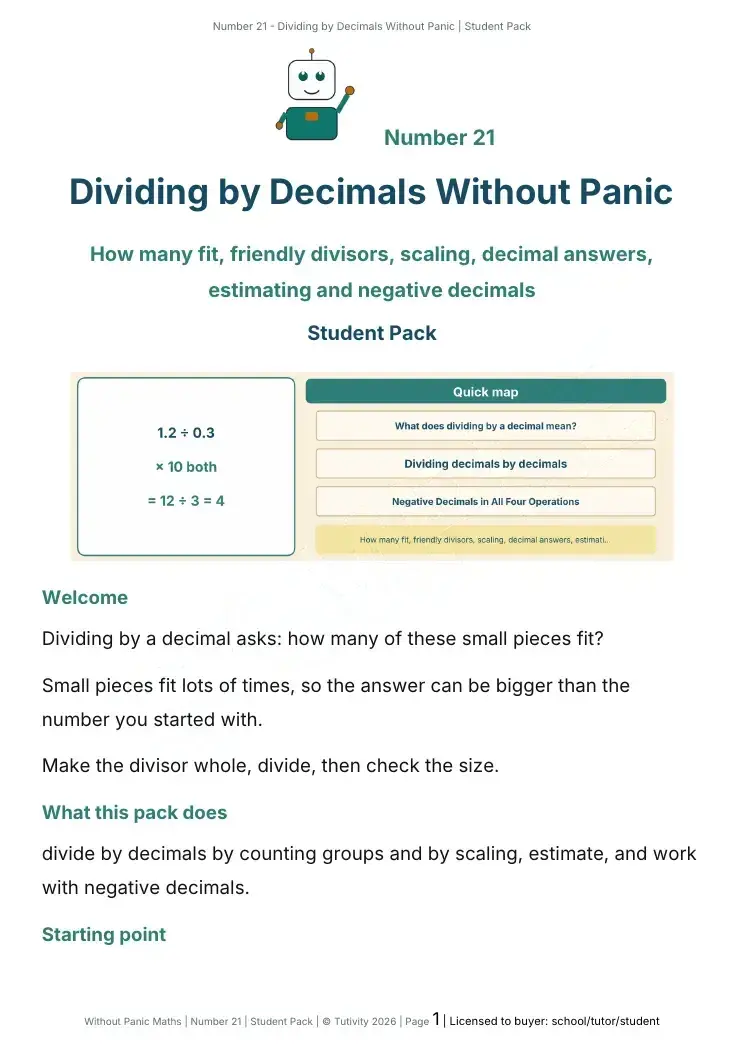
Dividing by Decimals
How many fit, friendly divisors, scaling, decimal answers, estimating and negative decimals
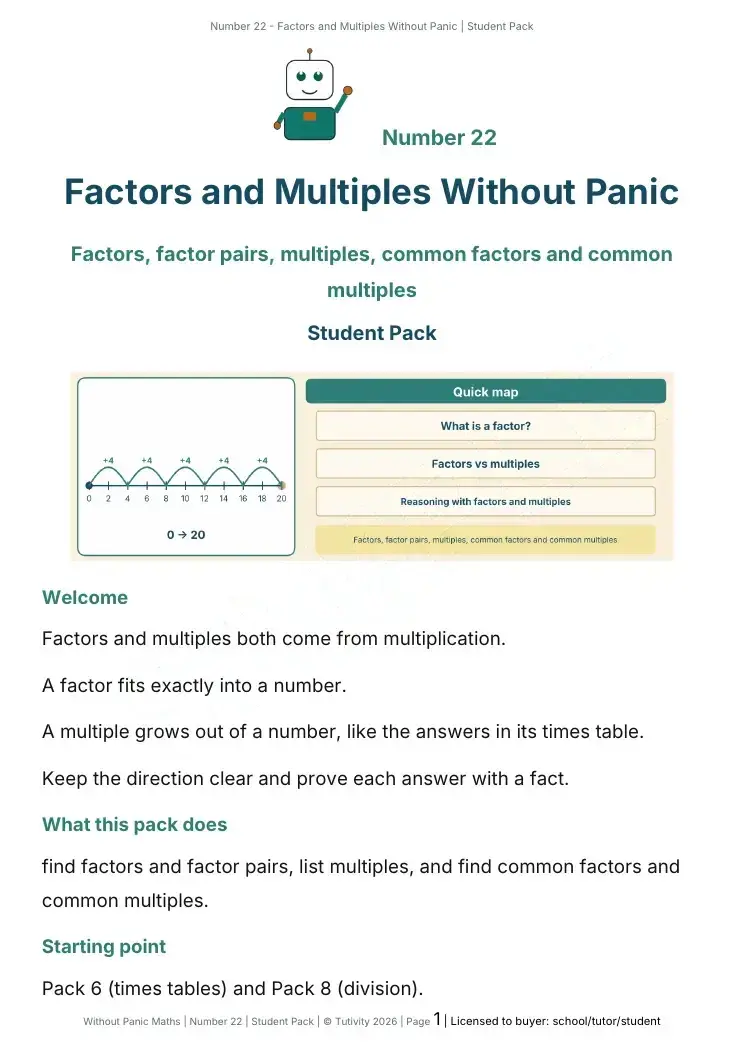
Factors and Multiples
Factors, factor pairs, multiples, common factors and common multiples
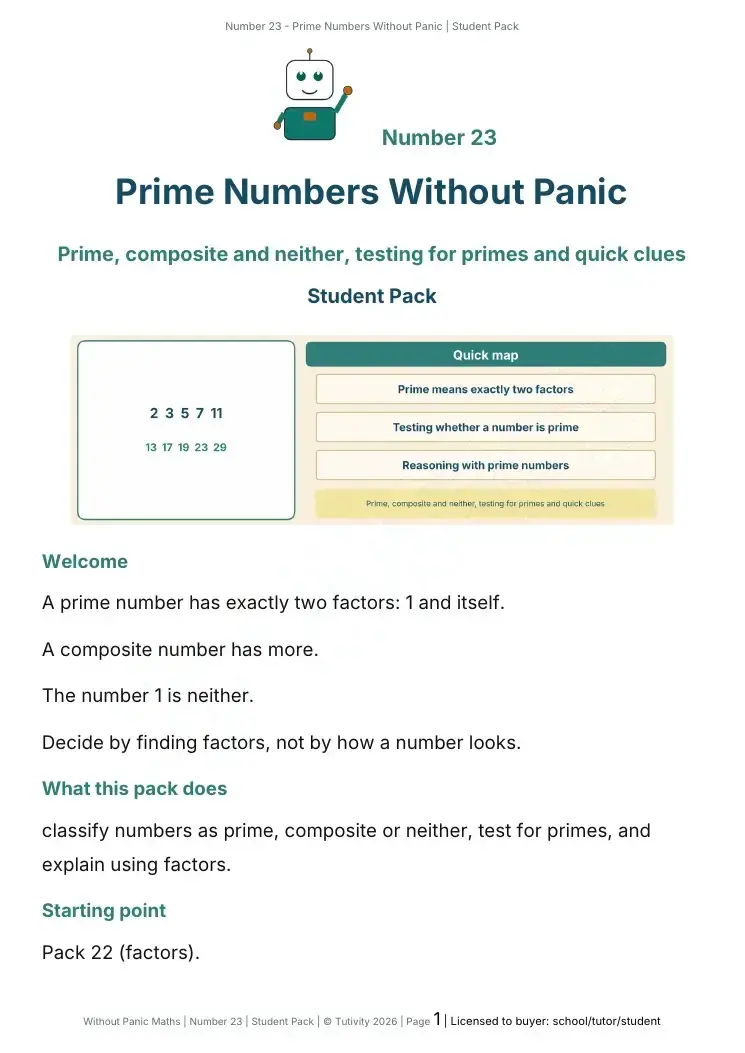
Prime Numbers
Prime, composite and neither, testing for primes and quick clues
Save with bundles
Buy a whole strand, year group or topic
60 bundles, from £9 starter topics to the complete collection.
Complete KS3 collection
All 209 packs across every strand and year group.
Number
54 packs · £182 £161
Algebra
48 packs · £161 £142
Geometry
50 packs · £168 £148
Ratio and Proportion
27 packs · £87.50 £77
Statistics
18 packs · £56 £49
Probability
12 packs · £35 £31
Buying packs
Simple and secure
Fill your basket
Add single packs or bundles. Packs already in a bundle are never charged twice.
Pay securely
Checkout is handled by Stripe: card, Apple Pay or Google Pay.
Download and print
Your Student and Teacher Packs download straight away, and the links are emailed to you.
A purchasing school or department may print and use its packs with its own classes and pupils. Tutors and families may use the packs with their own pupils or children. Packs may not be resold or redistributed.
Good to know
Questions about the packs
What do I get when I buy a pack?
Two PDFs: the Student Pack and a Teacher Pack with full answers. Download links appear straight after you pay and are emailed to you too.
Are any packs free?
Yes. The first pack in every strand and every diagnostic assessment are free to download, so you can try the approach before buying.
How do the bundles work?
Bundles group packs by topic, by year group, by strand, or the whole KS3 collection, at a lower price than buying each pack. If you add a bundle, any single packs it already includes are taken out of your basket so you never pay twice.
Can pupils work through a pack on their own?
Largely, yes. The pack does the teaching: give a pupil one short section at a time, then use the Teacher Pack afterwards to see what's clear and what needs another look.
Can I use the packs with my class or tutoring pupils?
A purchasing school or department may print and use its packs with its own classes and pupils. Tutors and families may use the packs with their own pupils or children. Packs may not be resold or redistributed.
Are the packs suitable for pupils with SEND?
They're written with SEND pupils in mind: one idea at a time, key words explained first, a visual for every idea and lots of small, achievable steps.
How is payment handled?
Securely by Stripe. You can pay by card, Apple Pay or Google Pay, and your card details never touch this website. Discount codes can be entered at checkout.
My download link has expired. What should I do?
Links last 30 days. Reply to your order email or get in touch with your receipt and we'll send fresh links.
Questions before you buy?
Not sure which packs suit a pupil? Start with the free diagnostic assessment for their strand, or get in touch.